

Hi! I’m Cristina. With roots in science and a track record leading strategy and partnerships across biotech, I focus on one thing: identifying breakthroughs that will make cell therapies mainstream and invest before the world catches on.
Thank you for coming back to read my thoughts! It means so much to me that you have kept up with my writing! This week I’m exploring what it really means to unlock access to cell therapies and why engineering better business models, automation, and smarter delivery strategies is where the most compelling investment returns will be generated.
A quick note before diving: for the sake of simplicity, I’m using “Gene Therapy” and “Cell Therapy” interchangeably here. I see Gene Therapy as a type of Cell Therapy, since the ultimate target of the intervention is the cell.
What Does Patient Access Really Look Like?
On September 22, 1702, during the Fiesta de Santo Tomás de Villanueva, Hospital Santo Tomás opened its doors on the Isthmus of Panama, then a Spanish colony. It was founded to care for poor women living nearby. Over the centuries, it has undergone several major transformations: after the Colombian Civil War in 1905; expanded under President Belisario Porras in 1924 to serve patients across all social classes; designated in 1980 as the home of Panama’s National Oncology Institute; and in 2000, five of its buildings were replaced with more modern facilities.
Affectionately known as El Elefante Blanco, the hospital has long served as a cornerstone of public health and a training ground for generations of Panamanian doctors and nurses. From its founding, it has remained committed to treating anyone, regardless of their ability to pay.
Today, more than a quarter of all babies in Panama are born at Hospital Santo Tomás. I was one of them, delivered there some years back for an optional fee of just $20, which my dad gladly paid.
As a child, I returned to Santo Tomás many times for the usual run of childhood illnesses. The experience wasn’t glamorous: you had to arrive at the crack of dawn, draw a number (yes, like at the deli counter), and wait for hours. Prescriptions were filled, free of charge for the patient. There was no ambiguity around access: if you were sick, you went.
I was lucky. I made it through childhood with only minor hiccups. But that wasn’t the case for the girl who lived across the street. We were growing up in the same middle-class neighborhood. She was born healthy, I was told. Then something changed. She couldn’t walk or talk anymore. Her mother took her regularly to the public hospital, but what she had had no treatment. The doctors did what they could and sent her home.
I remember watching her from across the street. Her mother brushing her hair as she sat silently on the porch, a distant glaze in her eyes. Until one day, she wasn’t there anymore.
Many years later, I thought about the girl who lived across the street again when I heard the story of another child - also born healthy - who began to lose the ability to walk, to talk, to play. This child was diagnosed with Metachromatic Leukodystrophy (MLD), a rare genetic disorder. His younger brother, diagnosed too with MLD, was about to participate in a clinical trial for a cell therapy designed to treat the root cause of his condition. Miraculously, it worked. He thrived alongside other children who received the experimental treatment.
Eventually, Libmeldy gained regulatory approval for the treatment of early-onset MLD with a price tag $4.25 million dollars for a single dose- equivalent to nearly 2% of Hospital Santo Tomás entire annual operating budget.
Would it have made a difference for the girl who lived across the street? We’ll never know. But what’s clear is that even today, far too many lives remain out of reach of these innovations.
“Of all the forms of inequality, injustice in health care is the most shocking and inhumane” - Martin Luther King Jr.
This therapy will remain confined to a handful of specialized treatment centers. Even in the U.S., if you're not born in California, Minnesota, Texas, Pennsylvania, or Georgia, accessing it is a complicated, uncertain journey. Today, access to this therapy, and other cell and gene therapies, is dictated first by where you live, and second by what you can afford.
How do we Redefine Access?
First of all, let’s start by clarifying access isn’t charity. It’s about market expansion. Every barrier we remove unlocks new geographies, populations, and revenues. That’s the kind of asymmetric upside investors rarely see and it's precisely why this conversation holds such significant weight for anyone committed to the future of health investment.
Let’s begin with a bit of hope.
On June 5, 2025, the FDA convened its first-ever Cell & Gene Therapy Roundtable, bringing together researchers, regulators, and patient advocates with a shared goal: how do we ensure that every family who needs these therapies can access them? The discussion centered on regulatory flexibility and ideas like platform designations, accelerated approvals, and the rare pediatric disease priority review voucher. What stood out the most was the strong alignment at every level.
Just a few weeks after the roundtable, the FDA issued meaningful updates to the labels of approved CAR T cell therapies. These updates relax certain post-treatment monitoring requirements which have been identified as logistical and geographical barriers to access. It is a step forward. But for most patients, it’s not going to make a difference.
Today in the US, only 2 in 10 eligible patients can access CAR T cell therapies. Globally, access is even worse (see table below). In most parts of the world, these therapies are not an option (not even on the radar!!). The reasons are many, but the outcome is the same: lives left behind. For investors, that gap signals both a human need and a tremendous, untapped market opportunity waiting to be unlocked.

We talk about drug prices a lot and yeah, it’s a big deal. The listed price of a drug can be the difference between someone getting the treatment or not. Those prices are set by manufacturers and influenced by everything from R&D costs, perceived value, plus the behind-the-scenes negotiations with payors and pharmacy benefit managers. Even Mark Cuban has made it his mission to tackle drug pricing through Cost Plus Drugs. But when it comes to cell and gene therapies, price is just one piece of a much bigger puzzle.
CAR-T therapies are curative for certain hematologic cancers, but they require a time-intensive and unpredictable manufacturing process and supply chain logistics. CAR-T therapies are delivered only at select, accredited centers with the infrastructure to manage severe adverse events. The U.S. reimbursement system (built around chronic disease management) struggles to accommodate one-time treatments with large upfront costs, delaying care and driving up non-medical burdens for patients and caregivers. And these challenges go far beyond CAR-T cell therapies.
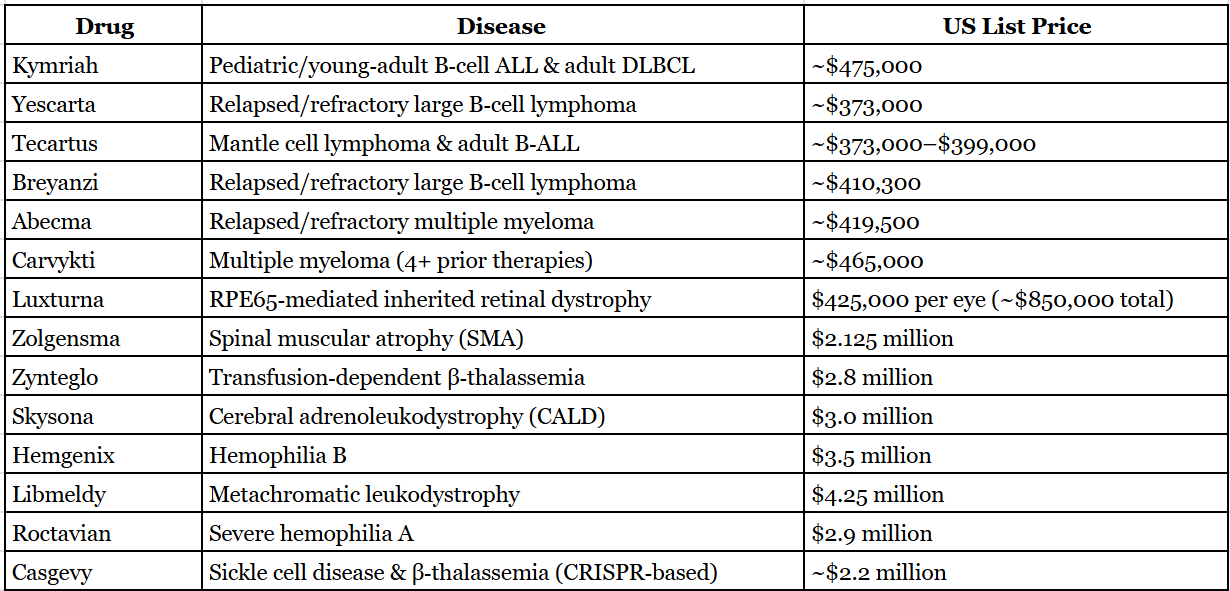
Since 2023, two curative gene therapies for sickle cell disease, impacting 100,000 Americans and millions more globally, have gained FDA approval. Yet fewer than 100 patients in the U.S. have received them. For comparison, Ozempic, a mass-manufactured, ready-to-use injection for diabetes and weight loss, has reached millions in just a few years.
Expanding the number of accredited centers delivering autologous therapies (like those for sickle cell disease) may ease some geographic friction; and, recent U.S. efforts, like CMS’s new initiative to expand access to these therapies are a promising step. But these efforts don’t address the deeper structural bottlenecks, particularly in regions where patient population is large, but infrastructure is limited. The core insight: this is not just a missed human opportunity, it’s monumental commercial opportunity.
Engineering Access to Cell Therapies
The next generation of cell therapies needs to be deployable, affordable, and built on simpler supply chain logistics. We’re past the point of asking whether these therapies work. The scientific proof-of-concept is there. The challenge is engineering the solutions that will get them to every patient who needs them. Just as shrinking transistors put a computer in every pocket, simplifying cell therapy could put a cure within everyone’s reach. That same shift is possible in cell therapy, if we rethink how we build and deliver it.
“The number of transistors on a microchip doubles approximately every two years, while the cost of computing is halved” - Gordon Moore
In this section, I’ll highlight a few ideas that could help us unlock the full potential of cell therapies.
Business Model Innovation: Rethinking the Blueprint for Exponential Growth.
We don’t need more science. We need better engineering, smarter incentives, and business models designed for growth.
I recently came across an article in the New York Times “Why Americans Can’t Buy the World’s Best Electric Car”. It’s about BYD, a Chinese EV company that’s quietly taking over the streets of China and outpacing Tesla in many global markets. BYD is reinventing the car business from the ground up. Its vehicles match the quality and tech of top tier brands but sell for under $10,000. How? BYD designs and manufactures nearly every core component in-house (batteries, semiconductors, motors, even their own fleet of ships!) and owns parts of the supply chain all the way down to the mines. That kind of integration lets them move faster, cut costs, and stay in control. Most other EV makers rely primarily on horizontal integration and source their key components from outside suppliers.
Cell therapy development and commercialization is operating on a blueprint built for small molecules and biologics. Full vertical integration may not be feasible, but rethinking the business model from ground up is essential. I’m saying that just like BYD, we need to re-imagine how to develop and commercialize these therapies so that we can put them in the hands of millions. It’s about unlocking entirely new revenue streams by making the impossible, achievable.
Automation: From Artisanal to Industrial Scale Returns
Most people don’t realize it, but many cell therapies today are still made in a surprisingly artisanal way. And while I can absolutely appreciate a good, handcrafted cheese, wine, or piece of furniture, we have to ask ourselves - is this really how we should be making life-saving medicine?
In biomanufacturing, “artisanal” means skilled technicians manually counting, pipetting, and monitoring cells, often step-by-step, across multiple unit operations. The whole process may last days to weeks. All of this happens in highly regulated cleanrooms, built to the highest standards to minimize contamination and ensure product safety. These cleanrooms are the backbone of quality manufacturing. But, for cell therapies, the process is also slow, labor-intensive, and highly sensitive to error. It’s a fragile system, vulnerable to staffing shortages, batch variability, and infrastructure limitations. And for patients, that fragility can mean treatment delays, disease progression, or in some cases, no therapy.
That’s why the future of cell therapies should involve automation, and more specifically: closed, low-touch systems that reduce human error and increase reproducibility. By using robots, software, and sensors, we can eliminate many of the manual steps that slow things down and introduce variability. And when you layer in digital twins and AI, we create the leap that can turn fragile, one-off manufacturing into a globally scalable, resilient system.
Once a process is automated, it can be replicated consistently, and deployed anywhere, not just in elite centers. We’ve seen this during the Industrial Revolution, craftspeople made goods by hand, one at a time. But it was the introduction of automation that transformed economies and made once-rare goods widely available.
A few forward-thinking companies are already working on this. The ones that succeed in building fully automated, small-footprint, low-touch systems with simple manufacturing processes will be the ones that truly change the game.
In this field, whoever figures out automation at scale will define the next era. That’s a foundational shift poised for significant, predictable returns.
Targeted Delivery: Simple, Powerful Tools for Global Reach.
One of the biggest challenges in the cell therapy field is this: how do you get the therapeutic payload (the “active ingredient”) to the right cells, in the right tissues, at the right amount, and at the right time? The delivery strategy impacts efficacy and drives up the stakes on complexity, cost, and scalability. And getting it wrong can make even the most promising therapies commercially unviable.
Over the years, this challenge has led to several creative approaches:
Ex vivo - take the target cells out of the patient, deliver the payload, and put the cells back in the patient.
In vivo with a viral vector - viruses have their preferred cells (tropism). Pick the right viral vector, load your payload, and let the viral vector do the targeting.
In vivo with a nanoparticle - If your target is the liver, great. Most nanoparticles and similar carriers naturally accumulate there thanks to the liver’s unique blood flow and function.
All three approaches have shown some degree of success and will likely co-exist for years to come. But each has serious limitations, especially when it comes to manufacturing at scale, ensuring broad patient access, and enabling repeat dosing.
The ideal solution is the biotech equivalent of the iPhone that Steve Jobs once imagined: simple on the outside, powerful underneath. Imagine an AI-optimized, virus-like particle that knows exactly where to go, is easy to make, doesn’t need to be given over and over again, and can be delivered with something as routine as an IV push. And most importantly, imagine it being affordable, not just for a few patients in a handful of centers, but for anyone, anywhere.
“Every once in a while, a revolutionary product comes along that changes everything” - Steve Jobs
This field is moving fast. With so many groups - from academic labs to startups to pharma - focused on programmable delivery platforms. And we’re seeing signs of momentum. In just the last six months, there’s been billions in M&A activity around targeted delivery technologies, especially those enabling in vivo manufacturing of CAR-T cells for oncology, signaling significant market demand for these simplified approaches.
We’re entering the age of programmable delivery. And in a few short years, we may look back at today’s challenges the way we now look at flip phones - necessary steps on the path to something transformational.
If this sparked ideas or challenged your thinking, I’d love to hear your perspective. What do you think it will take to make these therapies truly accessible? And what new possibilities could emerge if we succeed in reengineering how we deliver them? I’m happy to share deeper takes or connect you with others working in this space, just reach out!