

Hi! I’m Cristina. With roots in science and a track record leading strategy and partnerships across biotech, I focus on one thing: identifying breakthroughs that will help make cell and gene therapies mainstream and investing before the world catches on.
Thank you for coming back to read my thoughts. It truly means a lot to me that you’ve continued to follow my writing. This week, I found myself writing about Richard Feynman, and thinking about a world increasingly powered by AI, and who actually gets to experience the eureka moment.
I hope it sparks something!
I was 9 years old in a faraway land when, on January 28, 1986, the Space Shuttle Challenger broke apart 73 seconds into its flight, killing the astronauts onboard. I didn’t hear about it until 1996, when I visited the Smithsonian National Air and Space Museum in Washington DC for the first time. And it was much later, in 2019, when I learned about Richard Feynman’s role in investigating the cause and the significance of the O-ring seals’ elasticity in freezing temperatures. I have to admit I’ve watched that video of him dropping the clamped O-ring into a glass of ice water many times.
I’ve been fascinated by Feynman ever since. He was brilliant, curious, and a great science communicator, but what I think he really was, at his core, was a man constantly chasing that “eureka” moment. The joy that we humans get from finding out something. He spent more time thinking about how to solve the problem than acting on it, and for Feynman, thinking was the work, which made the eureka moments all the sweeter. He was playful and always pranking people, but I think even that was about finding out. He wanted to see the reaction, and the discovery of someone else’s surprise gave him tremendous joy. It’s the same thing we see in children when they figure out who is behind the sheet in a game of peekaboo, or when they lift the lid to find the toy underneath. It’s a joyful moment, and one that many of us parents love witnessing almost as much as the child loves experiencing it.
I believe these “aha” moments are fundamental to the human experience. We are constantly chasing them, consciously or not. As a child, I remember the joy of discovering who was really placing presents under the tree. Not disappointment, as you might expect, but genuine delight in the finding out. As a scientist, I chased those same moments in the laboratory, asking what happens if I change this gene, or introduce that one, and celebrating lit-up cells under the fluorescent microscope. And although those days at the bench are behind me, I still find ways to feel that rush. When we travel as a family, I insist on navigating without GPS. “I have an incredible sense of direction,” I tell the kids, with perhaps more confidence than is warranted. And often I do get us there, and although I rarely manage to impress them, I find real joy in arriving somewhere with just my senses.
Lately I’ve been thinking about all of this in the context of AI and drug discovery. There are hundreds of AI drug discovery companies right now, and some of them will almost certainly develop drugs that help people. But at this stage it is nearly impossible to distinguish which ones will actually make it. Most of these companies are building models trained on the same existing data, recycling what we already know (no “aha” moments). Some are even leveraging publicly available data, which we know skews heavily toward positive results and, perhaps more troublingly, a meaningful portion of it is not reproducible. Most of us who have been part of this ecosystem are very well aware of the open science problem that we are still collectively working to solve. Further, drug discovery is not like solving a math problem or writing lines of code, in that the verification comes much later through human clinical trials and real world data collection.
“For a successful technology, reality must take precedence over public relations, for Nature cannot be fooled” - Richard Feynman, Report of the Presidential Commission on the Space Shuttle Challenger Accident, 1986
Which is why I think the most interesting use of AI in biotech is not in drug discovery per se. The most practical and exciting applications of AI will be in helping us learn new biology, giving these models truly novel mechanisms and targets to work with. And, by new biology, I mean the cellular mechanisms that are entirely unknown today because they only emerge within the complexity of a whole, functioning living system, phenomena that controlled experiments, by design, cannot capture. And within that, the area I find most compelling is cell-fate engineering, and which I hope will eventually lead to the development of fully engineered tissues and organs. I am so excited for the founders generating high-quality data in this field, because they are the ones about to experience their own eureka moments. The convergence of new data and new tools brings with it a wealth of new context, and it is here where AI will shine, revealing unexpected pathways and raising questions we never thought to ask.
Which brings me to Shinya Yamanaka.
Shinya Yamanaka was born in 1962 in Higashiosaka, Japan, the son of a factory owner who made spare parts for sewing machines. As a boy, he spent hours dismantling clocks and radios just to see how they worked, and read scientific magazines voraciously, conducting home experiments that included one with an alcohol lamp that ended in a small fire and a stern reprimand from his mother. Interestingly, Richard Feynman’s favorite childhood hobby was also dismantling radios, and in his autobiography “Surely You’re Joking, Mr. Feynman!” he describes a small fire he caused as a child in his bedroom, lucky enough that his mother never found out. Two curious boys, decades and an ocean apart (Feynman grew up in Queens, New York) both setting small fires in pursuit of finding out how things worked.
But back to Yamanaka. He went on to medical school and became a surgical resident, where he quickly discovered that surgical dexterity was not among his gifts. So he left medicine in pursuit of something that suited him far better: scientific research. He started with a hypothesis that was, at the time, considered almost heretical: that the factors maintaining embryonic stem cells in their pluripotent state, capable of becoming any cell type in the body, might also be able to induce that same pluripotency in somatic cells, the specialized cells like skin or muscle that had long been considered permanently committed to their identity. Through painstaking combinatorial screening of candidate factors, following one biological trail after another in a pre-AI era, he found his answer in four reprogramming factors: OCT3/4, SOX2, KLF4, and MYC. Together, they could turn back the clock on a cell’s identity. He called the resulting cells induced pluripotent stem cells, or iPSCs, and in doing so gave rise to the entire field of cell-fate engineering.
As I’ve discussed in a prior post, since Yamanaka’s discovery we’ve been playing with iPSCs in remarkable ways, coaxing them forward into specialized cells for cell replacement therapies and winding them backwards to explore their utility in rejuvenation and aging.
“In 2005, we succeeded in generating ES-like cells with the four factors, and I named the resulting cells induced pluripotent stem cells or iPS cells.” - Shinya Yamanaka, Nobel Prize in Physiology or Medicine in 2012
The field of cell-fate engineering has grown rapidly. Today there are multiple companies leveraging iPSCs as their starting material, generating neurons, cardiac cells, pancreatic cells and more, with promising results. But the field is also constrained by the limits of what we actually understand about the underlying biology. There are hundreds of distinct human cell types and thousands of cell states, and then there are the additional layers of complexity introduced by the diversity of the human population, and by the cellular changes driven by environmental exposures and disease. We are working with an incomplete map of an extraordinarily complex territory.
Fortunately, a major effort is already underway to change that. The Human Cell Atlas, which launched in late 2016, is a global consortium on a quest to understand the 37.2 trillion cells in the human body and how each cell’s 20,000 genes are switched on or off in each cellular context. The effort was made possible by the development of high-throughput single-cell molecular profiling tools and spatial techniques that allow scientists to characterize cells directly within tissue samples, preserving the spatial relationships that tell us not just what a cell is, but where it lives and who its neighbors are. Having a comprehensive reference map of the molecular state of cells in tissues will be an extraordinary contribution to our understanding of how cells behave in aging and disease.
The challenge, as you can imagine, is that this project generates an almost incomprehensible volume of data. You might think it’s similar to building Google Maps. But I actually think it’s far more complicated than that. With Google Maps, we already knew where the roads were. The information about places existed somewhere, waiting to be compiled. The Human Cell Atlas is more like trying to map a dense rainforest for which we have a general sense of what is in there, but very little understanding of how you get from point A to point B, because there are no paved paths. We have been peering into this jungle for a while, and we know that everything is somehow interconnected. I believe this is where AI’s superpower of pattern recognition will be essential. It will not replace scientific intuition but it will help us process an incomprehensible amount of information, find patterns across it, and point us toward connections we would never have thought to look for.
What gives me particular optimism right now is not just the quality of the science, but the spirit in which it is being conducted. Something meaningful is shifting in how these teams operate. Rather than guarding their findings behind journal paywalls and competitive siloes, many of the most exciting groups working at this frontier are actively embracing an open science model, sharing data, tools, and methods in real time with the broader community. This is a recognition that the task is too big for any single lab to solve alone, and that the rising tide of high quality, openly shared biological data lifts everyone in the field. When I look at the convergence of better tools, better data generation, and a growing willingness to collaborate across institutional boundaries, I think we are approaching an inflection point that is without precedent. The pace of discovery in cell-fate engineering over the next decade may make the last two decades look slow by comparison, and in a field that has historically moved at the speed of a sloth descending from a tree, that is saying something. It’s really a remarkable thing to contemplate.
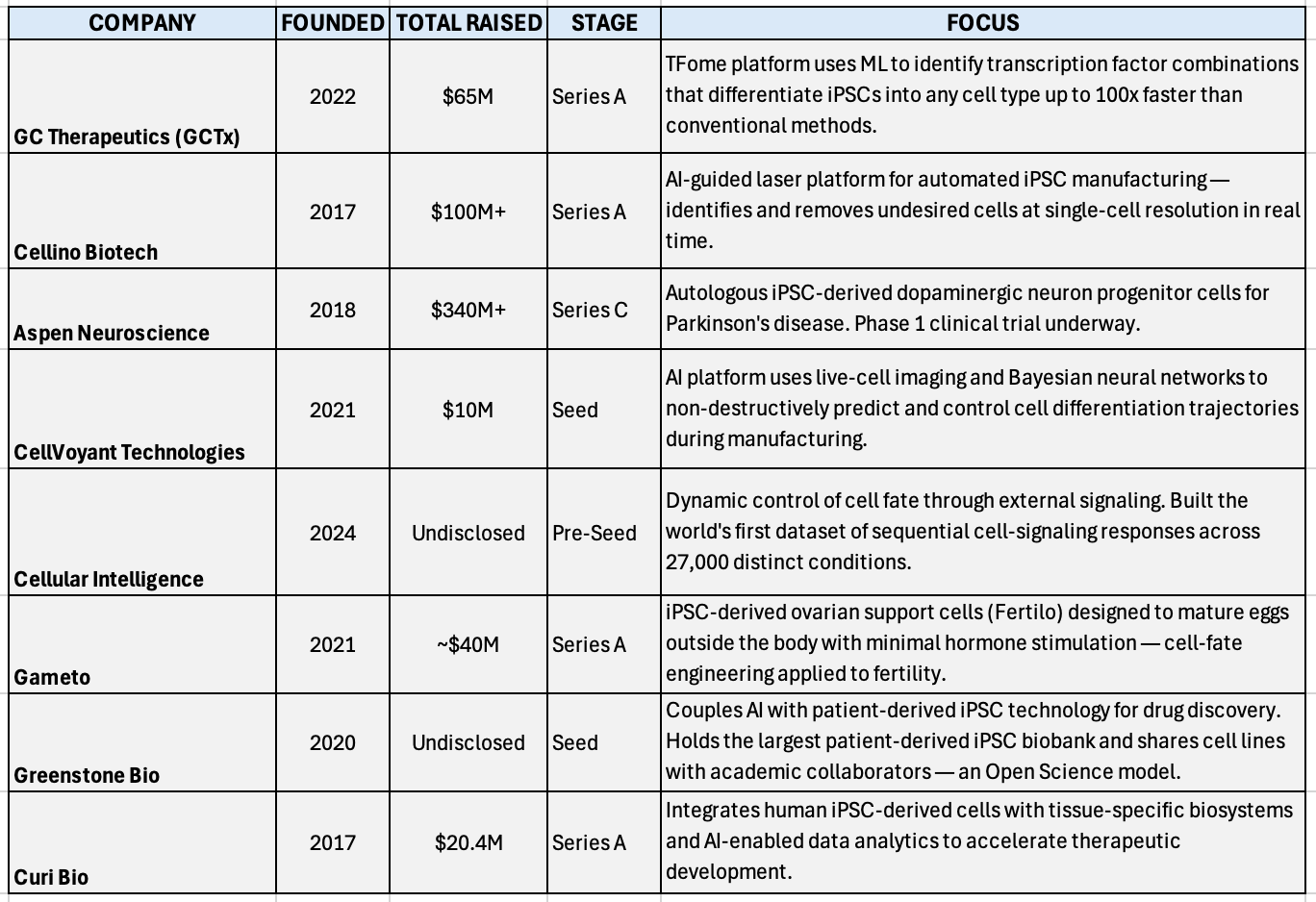
In the meantime, I’m closely watching the ideas and companies emerging in this space (Table 1), because the eureka moments still belong to us humans.
If this piece sparked something, whether it's a memory of your own eureka moment, a childhood curiosity you had forgotten about, an interest in cell-fate engineering or the Human Cell Atlas, or simply a newfound appreciation for Richard Feynman, I'd love to hear what resonated. What are you seeing out there? I'm always happy to keep the conversation going or connect you with others working at this frontier.
Germane to AI and aha moments, a snide take from reddit. h/t chris emig.https://www.reddit.com/r/comics/comments/1u22fsc/historys_greatest_thinkers_with_ai/