
Hi! I’m Cristina. With roots in science and a track record leading strategy and partnerships across biotech, I focus on one thing: identifying breakthroughs that will help make cell and gene therapies mainstream and investing before the world catches on.
Thank you for coming back to read my thoughts. It truly means a lot to me that you’ve continued to follow my writing. This week, I’m reflecting on the story of Katalin Karikó, what it means to be ahead of your time, and what we know about RNA-based medicines.
I hope it sparks something!
A teacher saw her first
People sometimes ask me: How did you get interested in science? Or how did you end up doing what you’re doing? Or even how did you end up staying in the U.S.? In my case, the answer almost always begins with a teacher. When I zoom out and look at the inflection points in my life, the moments where one small decision altered the trajectory, there is almost always a teacher nearby.
That’s why I wasn’t surprised to learn that when Katalin Karikó was a young girl growing up in Hungary in the 1950s and 60s, it was her high school biology teacher who first saw her. He nurtured her fascination with how biology works, encouraged her to enter academic competitions, and helped her believe that she, the butcher’s daughter, could pursue a research career. In her memoir, Breaking Through: My Life in Science, Katalin describes multiple moments where a mentor validated her thinking and removed friction at critical junctions. She also delves deeply into the challenges of being an immigrant and working in a highly competitive academic environment.
Katalin began working on RNA in the 1970s, more than 40 years before the first mRNA medicine was approved. At the time, RNA was known to be unstable and inflammatory, and it was widely considered impractical. She faced rejection after rejection with grants denied, funding pulled, multiple demotions, her work labeled unrealistic or even useless. Even after she and Drew Weissman discovered how to modify mRNA in ways that improved its therapeutic potential, their work was largely minimized.
Looking back, her story feels heroic. But structurally, it is not unusual.

In the 19th century, Max von Pettenkofer championed the miasma theory, the idea that diseases like cholera were caused by “bad air.” He was wrong about cholera; we now know it is caused by Vibrio cholerae, transmitted through contaminated water. Germ theory, advanced by Robert Koch and others, eventually prevailed. And yet, not all “bad air” thinking was foolish. A century later, we learned that pathogens like influenza and coronaviruses are indeed airborne. (Coincidentally, most airborne pathogens are RNA viruses - though not all.) Pettenkofer’s work on ventilation also led to what we now call the “Pettenkofer number,” still used as a benchmark for indoor air quality.Pettenkofer was wrong in part. And ahead of his time in part (like Katalin).
The thing about science is that every scientific breakthrough is built on top of many discoveries and the work of many different researchers. Katalin highlights this eloquently in her book, acknowledging that there is often an element of luck when a discovery that benefits humanity is recognized as such. More often than not, great science remains confined to the corners of a lab, known to a few, and sometimes buried as a publication in a lesser-known journal.
Today, many scientists estimate that we understand only 10–15% of functional biology in a truly predictive way. We have detailed maps of genes and pathways, but far less mastery over how living systems behave across contexts. There is data we simply don’t have, findings we can’t reliably reproduce, and biological changes we still lack the tools to measure.
I’m hopeful that when we have what Dario Amodei, CEO of Anthropic, calls “a country of geniuses in a datacenter”, AI systems capable of designing and running experiments faster than any lab, we won’t have to wait a century to close knowledge gaps. Hopefully, breakthroughs that benefit humanity will appear more frequently.
In the meantime, I’d like to focus on what we do know about functional biology and how we can leverage that knowledge to advance curative medicines to patients and perhaps convince ourselves to be the first ones willing to invest in a very deserving idea.
Now let’s talk about RNA-based therapies and what you should know if you’ve been considering investing in this space.
RNA is coming of age
For most of the history of medicine, drugs worked by targeting proteins. A small molecule would bind to an enzyme or receptor and either activate or block it. This is powerful but it leaves vast swaths of biology out of reach. Roughly 85% of the proteins encoded in the human genome have no known small-molecule drug binding site. They are, in the language of the field, “undruggable.”
RNA-based therapies change the calculation. Instead of targeting proteins downstream, they intervene at the level of messenger RNA (mRNA), the molecular instructions that tell a cell which proteins to make and how many. If proteins are the machinery, RNA is the blueprint. And blueprints are, in principle, far easier to edit, silence, or replace.
“They felt sorry for me when I said that I’m working with mRNA: ‘Oh my God, poor Kati” - Katalin Karikó, 2023 Nobel Prize in Physiology or Medicine
The field didn’t arrive here overnight. The first RNA-based medicine, Vitravene, was approved by the FDA in 1998 for cytomegalovirus (CMV) retinitis in AIDS patients. It was proof of concept, but the technology was fragile. RNA degraded quickly in the body, and immune reactions were a persistent problem. Further, delivery beyond the bloodstream seemed nearly impossible. And thus, for a decade, the field moved slowly. Then, two developments changed everything.
The first was the discovery of RNA interference (RNAi) by Andrew Fire and Craig Mello in 1998, showing that double-stranded RNA could silence specific genes with remarkable precision. Fire and Mello were awarded the Nobel Prize in 2006 for this discovery. The second was the validation of lipid nanoparticles (LNP) as delivery systems for RNA-based therapies, established with the approval of Onpattro in 2018, an RNA-based therapy used for the treatment of polyneuropathy.
Today, RNA-based FDA-approved therapies broadly encompass four major types, each operating through a distinct mechanism: antisense oligonucleotides (ASO) that bind target RNA directly, small interfering RNA (siRNA) that harness the cell’s natural RNAi machinery, synthetic mRNA delivered into cells to produce a desired protein, and RNA aptamers that bind specific proteins and act as competitive inhibitors.
There are more than two dozen approved RNA drugs, spanning neurology, cardiology, metabolic disease, rare genetic disorders and infectious diseases. Alnylam's siRNA franchise alone is on track to generate multiple billion-dollar products. Ionis, the pioneer of ASO chemistry, now has over a dozen drugs on the market and one of the deepest pipelines in biopharma.
The key bottleneck that remains today is delivery. Technologies like N-acetylgalactosamine (GalNAc) conjugation solve liver targeting by exploiting a receptor that’s abundantly expressed on hepatocytes. But the liver is one organ. The vast majority of genetic and acquired diseases live elsewhere: the brain, the lung, the muscle, the heart, the eye. I know some very interesting companies attacking this problem directly, using AI to design LNPs that can navigate to tissues beyond the liver. This is where the next decade of RNA medicine will be won or lost.
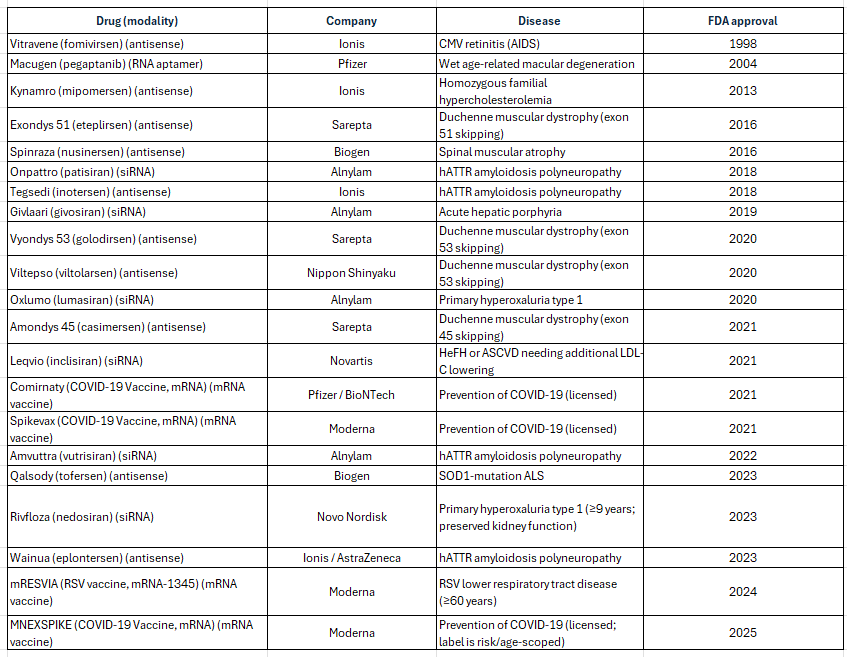
The table below captures every RNA-based therapy approved by the FDA to date. It is in many ways, a demonstration that a thing once thought impossible is now repeatable.
The Next Frontier: Circular RNA
If linear mRNA is a song that plays once and ends, circular RNA (circRNA) is like a vinyl record stuck in a loop that keeps playing. Conventional mRNA has exposed ends that cellular enzymes called exonucleases recognize and degrade, limiting its lifespan inside a cell to hours or a few days at most. CircRNA has no such ends. Its closed-loop structure confers a natural resistance to degradation, enabling sustained protein expression that can last weeks rather than hours.
CircRNAs open an entirely different design space. Therapies that currently require weekly or monthly dosing might become quarterly or even annual interventions. For chronic diseases, that’s a quality-of-life transformation.
The field is genuinely nascent. RiboX Therapeutics, a Chinese-based startup, dosed the first human patient with a circular RNA therapy in March 2025. Their candidate uses a circular mRNA to restore saliva production in head and neck cancer survivors. Orna Therapeutics, an MIT spin-off, is pursuing a more ambitious target with its self-circularization RNA platform advancing in vivo CAR-T therapy for autoimmune diseases and B-cell malignancies, using circular RNA to instruct the body to generate its own engineered immune cells. If it works, it could democratize a class of medicine currently available to only a fraction of the patients who could benefit.
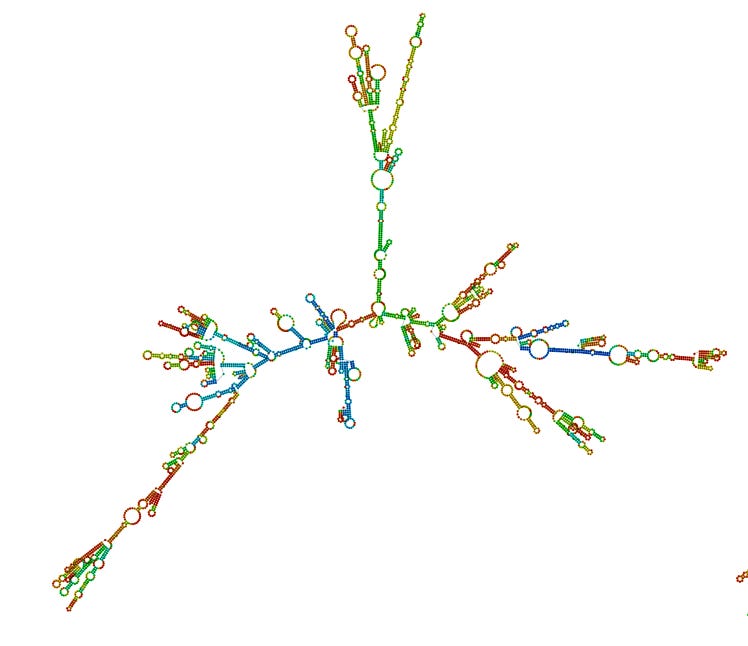
AI-guided designs are being applied across multiple platforms and companies. Large Language Models (LLMs) trained on large RNA sequence datasets, are being used to predict and optimize circRNA secondary structure, which governs both stability and translational efficiency. The three-dimensional fold of a circular RNA molecule determines how efficiently ribosomes access and translate its payload; small sequence changes can have dramatic downstream effects on protein output. Until recently, navigating this design space required laborious, low-throughput wet lab iteration. AI-driven structure prediction and generative sequence design are beginning to compress this cycle from months to days, allowing researchers to screen thousands of circRNA variants computationally before ever synthesizing a single molecule. I know some very cool startups working on exactly this, quietly, in stealth. And I think they're worth watching.
The surest signal that a platform technology has crossed from scientific curiosity to a commercial inevitability is when large pharma companies stop watching from the sidelines and start writing checks. The most recent deals tell a coherent story about where the field is heading.
Two strategically significant transactions have punctuated the emergence of circular RNA as a platform. In September 2025, Bristol Myers Squibb acquired Orbital Therapeutics for $1.5 billion. Orbital, was founded just three years prior by longtime Alnylam CEO John Maraganore alongside Arch Venture Partners and a16z, none of its candidates had been tested in humans. BMS is not paying for clinical proof but for platform optionality, and for the judgment of a team that helped turn RNA from a little-known molecule into the foundation of a new generation of blockbuster medicines.
Then, on February 9, 2026, Eli Lilly announced its agreement to acquire Orna Therapeutics for up to $2.4 billion. Orna’s lead program, ORN-252 targeting CD19, a surface antigen on the B cells driving conditions like lupus, rheumatoid arthritis, and multiple sclerosis. Preclinical data presented at ASH 2025 showed deep, sustained B-cell depletion in non-human primates without the need for preconditioning lymphodepletion, a meaningful signal that the approach could work. At $2.4 billion for a pre-clinical-stage asset, the price reflects not just what Orna has built, but what circular RNA as a platform is now believed capable of becoming.
Together, BMS's $1.5 billion bet on Orbital and Lilly's $2.4 billion acquisition of Orna, nearly $4 billion committed to circular RNA platforms with no approved products, represent one of the clearest signals in recent biotech history that a new modality has arrived.
At the end of her memoir, Katalin reflects on how far she has come from the butcher’s daughter in a small Hungarian town to a scientist speaking on stages alongside some of the most recognized figures in the world. For decades, the biology of RNA and its potential to improve the human condition was known only to a small group of researchers working quietly at the edges of the field. But from where I’m sitting, RNA is now stepping onto the main stage.
Today, we know enough to see the direction of the field, enough to recognize the platforms worth backing, and enough, at least in my view, to leverage this science to advance meaningful therapies to patients.
If this piece sparked something, whether it's a memory of a teacher who changed your trajectory, your own immigrant story, an interest in RNA biology, or curiosity about the companies quietly working on what's next, I'd love to hear what resonated. What are you seeing out there? I’m always happy to keep the conversation going or connect you with others working in this field.