
Hi! I’m Cristina. With roots in science and a track record leading strategy and partnerships across biotech, I focus on one thing: identifying breakthroughs that will make cell therapies mainstream and invest before the world catches on.
Thank you for coming back to read my thoughts! It means a lot that you’ve stayed with me on this writing journey. This week, I’m reflecting on what Daniel Kahneman’s work can teach us about investing, especially how to avoid predictable biases and make higher-quality decisions. In a field where FOMO and big names often drive capital, I’ve chosen a systematic approach that prioritizes disciplined decision-making to create stronger outcomes for patients and more compelling investment returns.
Fast, slow, and high stakes
I’ve been thinking a lot about the life and work of Daniel Kahneman, the Nobel laureate who passed away recently. His work showed us again and again that even the smartest minds are prone to predictable errors and biases. Alongside Amos Tversky, he pulled back the curtain on how our brains make decisions in Thinking, Fast and Slow. And more recently, in Noise, he revealed just how costly inconsistency can be in high-stakes decision-making, including those with massive economic consequences.
Kahneman’s journey into behavioral economics started in the Israeli Army. As a young psychologist, he discovered that gut-driven interviews to select officers were no better than random guesses. Instead of relying on instinct, he built a simple formula based on objective measures. It wasn’t popular with senior officers at first, but once implemented, it consistently outperformed intuition.
I can’t help but wonder, what’s the equivalent formula for investing in private companies? In a world where uncertainty is unavoidable, how do we make decisions grounded in more than gut feelings, social proof, or convenient biases?
Because, let’s be honest, if a big-name VC is leading a round, if a Nobel laureate is on the cap table, or if a friend is investing, it’s tempting to dive in without hesitation. That’s FOMO at work. The fear that if we don’t move fast, we’ll miss out on the next big thing. But Kahneman would likely remind us: that’s exactly the moment to pause and ask, what are we really betting on?
“The pain of losing is psychologically about twice as powerful as the pleasure of gaining” - Daniel Kahneman, Thinking, Fast and Slow (2011).
From Operator to Investor
The path to investing in enabling cell therapy platforms became clear to me when I realized that many investors, despite their conviction, don’t always grasp the technical complexities behind the companies they back. The field has already reached a series of well-defined milestones, and the trajectory is obvious to those of us inside it. Yet, capital often follows names rather than scalable solutions. To be clear, this isn’t about dismissing the contributions of renowned investigators and institutions that have built the foundation we now stand on. But if cell therapies are going to deliver on their promise, scalability must be the primary focus.
Venture investment is about big risks and big rewards. Given that cell therapies have delivered sustained remissions where other approaches failed, it’s tempting to assume that every new tool will be a slam dunk. But biology resists shortcuts. The cell - the ultimate target of these therapies - is a responsive node inside a vast system of networks, influenced by genetics, environment, and exposures. Despite decades of genomics, proteomics, and more recently, metabolomics, we’re only beginning to sketch out how these networks interact. Betting on tools to precisely control such systems without acknowledging the risk is like sailing into open seas without a map - possible, but reckless.
That’s why I believe informed investment decisions require a clear-eyed view of both opportunities and trade-offs. For cell therapies, this means distinguishing between proof-of-principle (an idea that might work) and proof-of-concept (an idea with sound scientific reasoning that could scale and translate). Only by applying what we do know about biological networks to engineering solutions, we can advance therapies that will benefit humanity.
When it comes to scalability, the biggest opportunities in the sector are:
Off-the-shelf technologies - truly scalable solutions such as stem cell-derived platforms where a single master cell bank ensures reproducible manufacturing of many batches
Targeted delivery tools - simplifying logistics and opening access by overcoming current supply-chain barriers to market reach.
Closed, automated system - reducing human error and increasing reproducibility in manufacturing and drug product preparation.
Encouragingly, many of these technologies already stand on a solid scientific foundation, with exploratory experiments pointing the way forward. We’re also beginning to see strong market validation, from multi-billion-dollar acquisitions like Capstan, EsoBiotec, Interius, etc., to growing demand from pharma for enabling delivery and manufacturing platforms. These signals illustrate a collective recognition that the next wave of cell therapy innovation will depend on scalable solutions.
The diversity of approaches also creates room for portfolio level diversification, which is essential for de-risking while still capturing upside. This framework has guided my own approach to channeling capital where it can do the most good and build the most value. And, instead of relying on the fast, intuitive judgments that often drive investment decisions, I slowed the process down. I started at a portfolio level, running classical forecasting models - tools I was fortunate to learn during my consulting days. By stress-testing different scenarios (e.g. missing signals, instincts right but timing off, generational winners, etc.), the models still converged on the same conclusion. The results pointed toward favorable risk-reward profile and suggested that disciplined investment in the sector could be both, impactful and profitable.
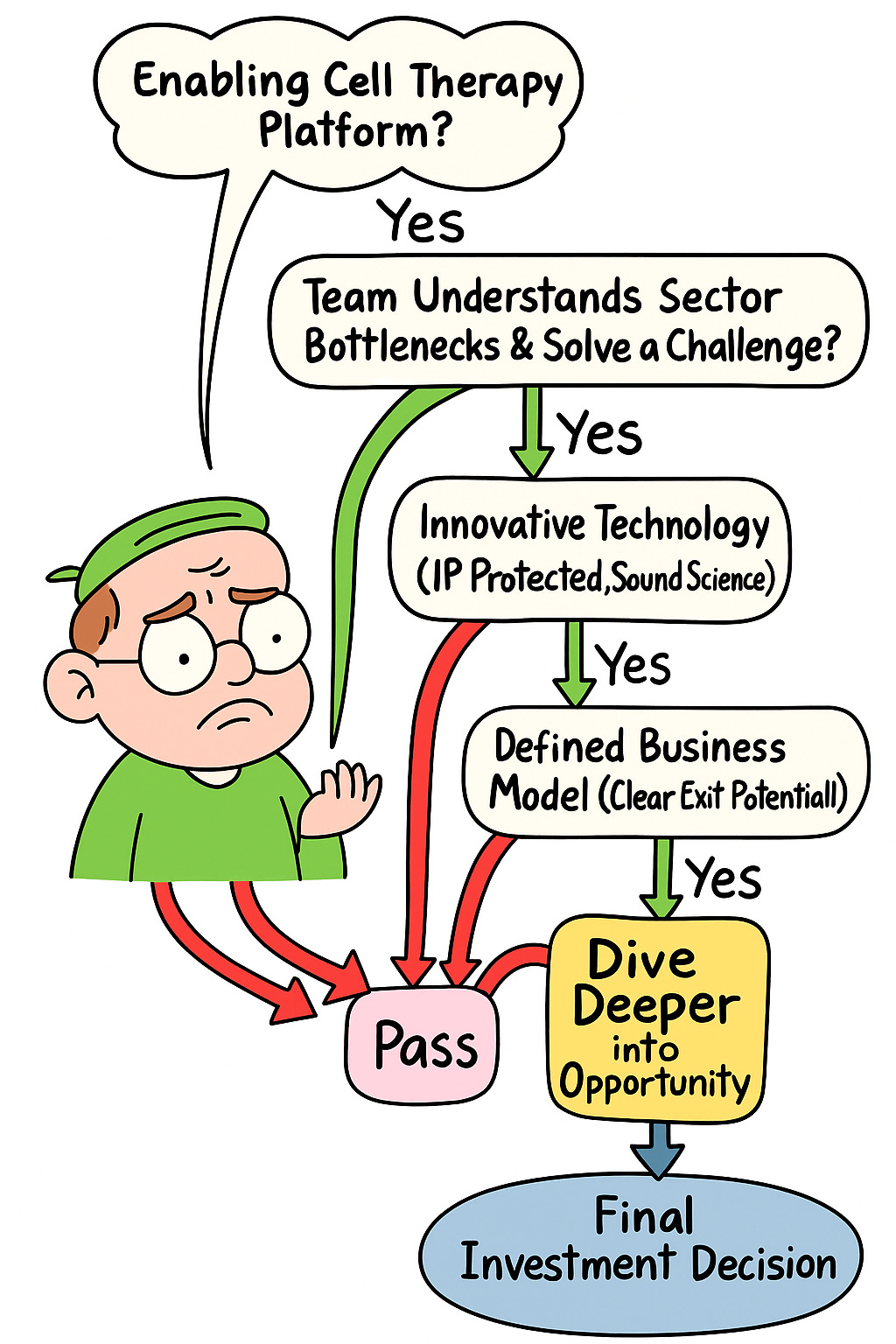
At each individual deal level, each investment is an attempt to solve a single challenge in the sector. And each attempt is executed by a founder who has a clear understanding of the bottlenecks ahead. Beyond scientific strength, viable business models, regulatory paths, IP protection, and market targets, value alignment remains non-negotiable. The goal is to back founders whose vision aligns with maximizing patient impact. Ultimately, this adds up to a repeatable algorithm for decision-making designed to limit cognitive biases, reduce heuristics, and raise the quality of each bet.
Looking ahead
If the goal is not just to chase the hottest trends, but to back companies that will move the needle for curative therapies - while also maximizing returns- the real challenge is knowing which companies, which technologies, and which founders to back.
I’ll admit I started this exercise from a very personal place. After nearly two decades in the sector, I’ve become deeply passionate about the transformative potential of these medicines. I believe many of the most devastating diseases of our time will one day be alleviated through one-time, curative therapies, and my goal is to help bring those treatments to as many people as possible.
The decision to invest in the space was straightforward because it clearly aligned with my values and I know the field very well. But deciding where to focus required a more disciplined process: balancing near-term vs. long-term opportunities, weighing risks in a capital-driven economy, and acknowledging the inevitable trade-offs that every “yes” means leaving other opportunities behind.
“One should not judge a decision by its outcome, but by the quality of the process” - Ron Howard, father of Decision Quality
As the late Ron Howard, Stanford professor and father of Decision Quality, often said, the key is making each decision high quality. With that in mind, I’ve built a systematic process to guide each investment decision moving forward, and I’m excited to see how the bets we place today will deliver both, meaningful patient impact and outsized returns.
This approach, I think, is exactly what Kahneman would advise.
If this sparked ideas or challenged your thinking, I’d love to hear your perspective. What do you see as the biggest blind spots or biases shaping biotech investment today? I’m happy to share deeper takes or connect you with others working in this space, just reach out!”